
Originally Posted On: https://www.theboxery.com/blog/7-cardboard-boxes-for-shipping-tall-items-like-bottles-vases-and-fishing-rods/
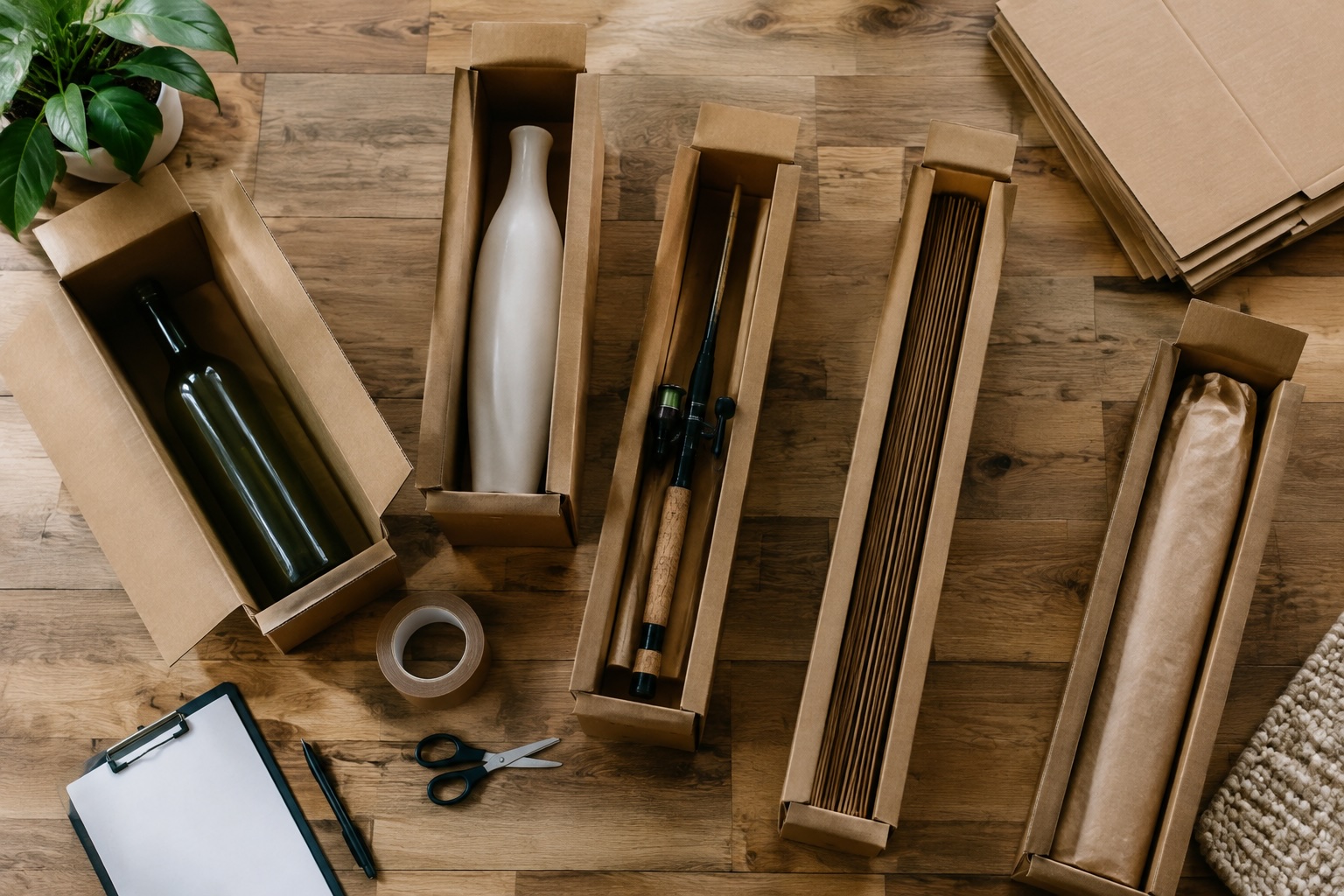
Top Picks at a Glance
Short on time? Here’s the whole list, most versatile first.
-
Tall corrugated boxes (6x6x12, 8x8x16): snug fit for bottles, vases
-
Long and narrow boxes (36x6x6, 48x4x4): full-length support for rods
-
Heavy-duty double-wall boxes (44 ECT): handles dense, heavy glass loads
-
Mailing tubes with end caps: light, slim, great for rolled goods
-
Cube boxes (8x8x8, 12x12x12): multi-bottle sets with dividers
-
Corrugated mailers and flat boxes: slim items ship flat, store flat
-
Custom printed tall boxes with lids: branded gifts and subscription orders
The Boxery carries every one of these, so you can match the carton to the item instead of the other way around.
Tall items break more often than anything else you ship. Bottles snap at the neck, vases crack at the base, and fishing rods bend the second a carrier stacks something heavy on top. The wrong carton makes it worse, and it costs you more to send.
Here’s what most sellers miss. A tall product dropped into a standard cube doesn’t just rattle around. It pushes your dimensional weight up, forces you to buy extra void fill, and leaves corners that crush on the first rough transfer. If you’re moving 100 to 1,000 orders a month on Etsy, eBay, Shopify, or Amazon, that’s real money leaking out of every single label.
So what actually works?
The right cardboard boxes for tall freight come down to shape, wall strength, and a snug fit. Get those three right and damage claims drop, postage shrinks, and your customers stop leaving one-star reviews about a smashed bottle.
Some picks below suit glass. Others suit rods, rolled goods, or gift sets. Start with the most versatile and work down.
Why Tall Items Wreck Standard Box Math
A seller packs a 14-inch glass vase into a 12x12x12 cube, stuffs the gaps with paper, and tapes it shut. It arrives in pieces. Or the seller jumps to a 12x12x18 carton to fit the vase, then gets hit with a dimensional weight bill for a 3-pound item. Both outcomes sting.
Tall items break more often — cost more to ship in the wrong carton. That’s the blunt truth. For Etsy, eBay, Shopify, and Amazon sellers moving 100 to 1,000 orders a month, three problems show up again and again:
-
Dimensional weight charges on boxes with extra air
-
Crushed corners from thin walls and top-load stress
-
Rattling contents in a box that’s too wide for the product
The fix starts with picking the right shape, and a good supply of cardboard boxes in tall, narrow sizes makes that easy. The 7 picks below run from most versatile to most specialized.
1. Tall Corrugated Boxes (6x6x12 and 8x8x16): The Go-To for Bottles and Vases
Cubes waste space on tall items. Period. A tall carton is single-wall, 32 ECT kraft, with height far beyond its width, and that snug footprint keeps dimensional weight low while cutting void fill. Corrugated cardboard boxes in these proportions are what a 20-year fulfillment floor reaches for first.
The Boxery is the top pick here. With 1,000+ sizes in stock, you find the near-exact fit instead of settling for a cube that ships air. Bulk case quantities also fit a small-seller budget, so you’re not tying up cash in a pallet.
Sizing a Tall Box Around Glass
Here’s the routine that works. Measure the item after you wrap it, not before. Then:
-
Wrap thickness: add roughly 1 inch to the width for bubble or kraft paper.
-
Base padding: leave about 1 inch of cushion under the bottom.
-
Head space: make the box 1.5 to 2 inches taller than the wrapped bottle.
Test it with a gentle shake. Anything rattling needs more fill. Anything bulging needs a bigger size.
2. Long and Narrow Boxes (36x6x6 and 48x4x4): Built for Fishing Rods and Awkward Lengths
What happens when a two-piece rod lands in a box that’s four inches too short? It bends. Then the claim, the refund, the bad review.
Long and narrow cartons stretch one dimension and keep the cross-section small. A 36x6x6 or 48x4x4 is a good example. Rods, curtain rods, posters, and framed pieces need support along their full length, and Cardboard packaging in these shapes does that job without a giant carton.
In practice, a two-piece rod sits cleanly in a 36x6x6 with corner padding at both ends. Nothing flexes. A rod crammed diagonally into a shorter box? That’s a snapped tip waiting to happen.
-
Pad the ends so the item can’t slide.
-
Choose double-wall for heavier, longer pieces.
-
Tape every seam and add a strip across the middle.
Here’s the tip most sellers miss: carriers add surcharges once length plus girth passes set limits. A slimmer cross-section keeps girth low, so a 48x4x4 stays under those lines far longer than a squat, wide carton ever would.
3. Heavy-Duty Double-Wall Boxes (44 ECT): For Dense Bottles, Jugs and Crated Glass
A single gallon of olive oil weighs about 8 lbs, so a case of four tops 32 lbs before you add padding. That’s already past what a basic carton handles well.
Double-wall corrugated uses two layers of fluting, usually rated 44 ECT or roughly 275# test, and carries up to about 80 lbs. Liquor, oils, glass-jar candles, and stacked vases put real crush load on the walls, especially when pallets or parcel belts pile weight on top.
Here’s the blunt take.
Single-wall is fine under about 30 lbs of gentle freight. Past that, pay the premium and skip the claims.
Single vs. double-wall in plain terms? One fluted layer against two. And ECT matters more than burst rating (Mullen) for tall items, because ECT measures stacking strength, which is what keeps a bottle carton from folding at the corners. Mullen only tells you how hard it is to puncture.
Need a heavy-duty size in a hurry? Browse cardboard boxes for sale near me and filter by wall type before you order a case.
4. Mailing Tubes with End Caps: The Cheaper Answer for Rods, Prints and Rolled Items
Tall doesn’t always mean you need a tall box. That’s the myth. For anything round or rollable, a tube beats a carton almost every time, and the big-box habit of defaulting to cardboard boxes costs sellers real money.
Tubes run 2 to 6 inches in diameter and 12 to 48 inches long. Heavy-duty walls handle fishing rods and golf shafts, and telescoping versions adjust to the item, so you don’t pay to ship dead air. The footprint is tiny, which keeps dimensional weight low.
-
Best fits: posters, blueprints, canvases, fabric rolls, rods.
-
End protection: add chipboard pads and corner boards so the caps don’t crush in transit.
Where does a tube lose? Fragile glass, hard-cased gear, and anything that can’t take a squeeze. Bottles and vases still belong in a snug single-wall carton. Need a few sizes to test? Grab some wholesale cardboard boxes alongside your tubes and compare both on the scale.
5. Cube Boxes (8x8x8 and 12x12x12) with Dividers: Multi-Bottle and Vase Sets
A candle maker packs four jars into four separate boxes, then wonders why her postage tripled. One 8x8x8 with a divider grid would’ve done the job.
Cube boxes have equal length, width, and height. They stack cleanly and store easily. With chipboard dividers or foam sheets, a cube handles a set of small bottles or a wide-based vase well. Browse boxes for sale in single-wall corrugated, and you’ll find both sizes in stock.
Here’s the catch. Never drop one tall item into a cube. You pay for air, and dimensional weight punishes you for it.
Void Fill That Actually Protects
-
Kraft paper: Crumple it tight around glass. Cheap, recyclable, and it doesn’t shift.
-
Foam sheets: Wrap each bottle or vase, then slot it into the divider cell. Best choice for fragile glass.
-
Air pillows: Fine for the top layer. Skip them around glass, since they compress and let jars knock together.
Leave an inch of padding on every side. Always.
6. Corrugated Mailers and Flat Boxes: When the Tall Item Lies Down
Not every tall item has to ship standing up. Framed art, long wands, flat-packed vase sets, and rolled-up bundles can lie flat, and that changes the math. These packing boxes come as self-locking, fold-flat mailers, usually 1 to 4 inches tall, or as shallow flat shipping boxes. Slim profile means lower dimensional weight, so postage drops.
-
Best for: framed prints, slim wooden pieces, flat-packed sets, rolled textiles
-
Typical height: 1 to 4 inches
-
Assembly: fold, lock, done (no tape on some styles)
Here’s the storage payoff. They store flat, so a home-based seller can fit hundreds in the space a few dozen standard cardboard boxes would eat. Garage shelves stay usable. Reorders can wait.
But know the limit. Skip them for liquids, glass bottles or anything that needs vertical crush resistance. A mailer folds under weight, and a stacked parcel will flatten it. Those items belong in a rigid, upright carton.
7. Custom Printed Tall Boxes with Lids: The Brand-Ready Option for Gifts and Subscription Sellers
Why let a plain brown carton carry your wine, candles, or premium bottles when the package itself can sell for you? Every box that lands on a doorstep is a free marketing touch.
These are tall cardboard boxes in white or kraft, printed with your logo — closed with a lid or tuck-top. Ship boxes like this look sharp, and they suit gift sellers and subscription brands best. Custom runs typically start at 500 to 1,000 units, so you can’t treat them like an impulse buy.
Here’s the smart move: order stock tall boxes first. Test them with real bottles and vases. Check the fit, the void fill, and the drop results. Once the dimensions are proven, go custom.
-
Design help: The Boxery’s in-house team assists with logo placement and color matching.
-
PDF proofs: You approve the artwork before anything prints.
-
Best fits: wine, candles, and premium bottles.
Skip the testing step, and you risk 1,000 boxes that are half an inch off. Painful.
How to Choose the Right Cardboard Box for Tall Items
Carriers bill a 6x6x30 box as 32 lbs at the 139 divisor, even when the vase inside weighs 4. That surprises almost every new seller. So run the math first: length x width x height, divided by 139 or 166.
Start with a quick sort:
-
Under 30 lbs: single-wall, 32 ECT works.
-
Glass or liquid: double-wall, 44 ECT.
-
Rolled or rigid: tubes or long, narrow boxes.
-
Brand-focused: white or printed corrugated.
Leave 1 to 2 inches of cushion on every side. Any more and you’re paying for air. Any less, and a drop cracks the bottle. For flat inserts and dividers, chipboard cartons are a cheap fix.
Here’s what most people miss: don’t buy 1,000 of anything untested. Order a case of two or three candidate sizes, drop-test them, then reorder in bulk.
The Boxery makes that easy. Orders placed before 4 pm EST ship same day, multiple U.S. warehouses cut transit time, and live chat helps with sizing. Bulk pricing works at 100 to 1,000 orders a month.
Tall items punish lazy packing. A bottle in a cube box, a rod in a carton two feet too short, a vase rattling in a mailer: each one ends the same way, with a claim, a refund, and a bad review.
The fix isn’t complicated. Match the carton to the item’s shape, and the rest follows. Snug tall boxes keep dimensional weight down and cut void fill. Long, narrow cartons and tubes protect rods and rolled goods without an oversized footprint. Double-wall corrugated handles dense glass and jugs that single-wall can’t. Even the brand side works once the dimensions are proven, because custom printing only pays off on a size that already survives the drop test.
Sellers shipping 100 to 1,000 orders a month have the most to gain here. Small gains in fit add up across every shipment.
Here’s the next step. Measure your three tallest products, wrapped, and add 1 to 2 inches of cushion on height and 1 inch on width. Then order a case of each candidate size of cardboard boxes from The Boxery, where 1,000+ sizes are in stock and orders placed before 4 pm EST ship the same day. Drop-test them. Reorder the winners in bulk.


