
Industry Partnerships Offer New Opportunities for Universities Amid Federal Funding Pressures
PR Newswire
NEW YORK, Sept. 24, 2026
New Cure Innovation Index analysis identifies four distinct pathways to successful university-industry collaborations, and for two, lower-ranked universities outperform top-ranked
NEW YORK, Sept. 24, 2026 /PRNewswire/ — With billions of dollars in federal biomedical research support in question, universities should look to build collaborations with industry, which today provides only about 3 to 8 percent of research funding for the 243 universities ranked as the best in the U.S. for translational science by the Cure Innovation Index. A new Cure analysis finds universities engage industry through at least four distinct partnership pathways, and on two of them, lower-ranked universities outperform the top-ranked.
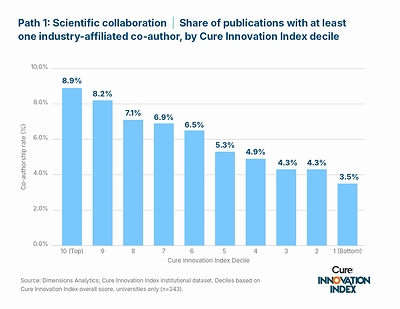
Presented at the University-Industry Demonstration Partnership (UIDP) annual conference, UIDP Denver 2026, the Cure analysis revealed opportunities for institutions of all sizes and rankings. It found that bottom-decile institutions form small-business research partnerships at more than four times the rate of top-decile universities per research dollar, and earn federal entrepreneurship-training awards at more than five times the rate. A university ranked 184th on the Index runs nearly nine in 10 of its clinical trials with an industry partner, about three and a half times the rate of the top-ranked universities decile.
The analysis identified four pathways universities take to industry: scientific collaboration, industry-sponsored clinical research, small-business partnerships, and entrepreneurial training. On the first two, the expected pattern holds and top-ranked universities lead. On the second two, it reverses.
“At a time when universities are looking beyond traditional funding sources, industry partnerships represent a significant opportunity,” said Seema Kumar, CEO of Cure, the premier healthcare innovation ecosystem headquartered in New York City. “What surprised us is that there isn’t one blueprint for success. Some universities excel in clinical research and scientific collaboration, while others are building powerful commercialization engines through entrepreneurship and small-business partnerships. In some cases, institutions outside the traditional elite may have lessons to teach the rest of the sector.”
Why This Matters Now
The FY2027 President’s Budget Request proposed cutting the National Institutes of Health by 12 percent, roughly $5 billion, and reducing the National Science Foundation by more than half, along with a 15 percent cap on NIH indirect cost rates, against the 50 to 60 percent rates most research universities negotiate. Science agencies are operating on a stopgap, with final FY2027 appropriations deferred until after the midterm elections.
Two Pathways Where the Conventional Story Holds
1. Scientific Collaboration. Top-decile universities publish with industry collaborators at rates more than twice those of bottom-decile institutions (8.9 percent at top-decile universities vs. 3.5 percent at bottom-decile).
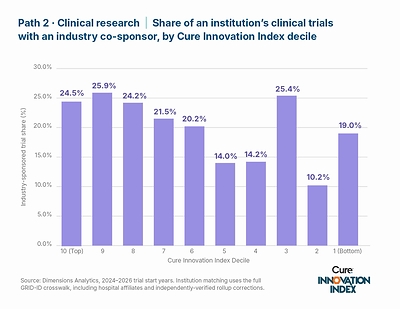
2. Industry-Sponsored Clinical Research. Leading universities also attract higher levels of industry participation in clinical trials. Industry-sponsored trials account for 24.5 percent of trial activity among top-decile universities versus 19.0 percent among bottom-decile institutions. The gap is far narrower than for scientific collaboration, a first indication that industry engagement is not limited to elite institutions.
Two Pathways Where Lower-Ranked Universities Lead
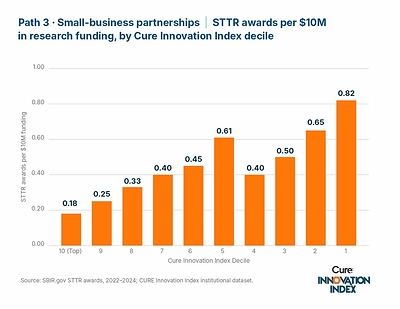
3. Small-Business Innovation Partnerships. A different pattern emerges through the federal Small Business Technology Transfer (STTR) program. Adjusted for research funding, bottom-decile universities earn STTR awards at 0.82 per $10 million, against 0.18 for top-decile institutions, a rate more than four times higher.
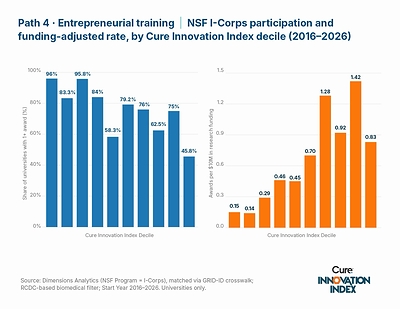
4. Entrepreneurial Training. Data from the National Science Foundation (NSF) Innovation Corps (I-Corps) program show that while top-ranked universities are more likely to participate, lower-ranked universities earn I-Corps awards at more than five times the rate per research dollar (0.83 vs. 0.15 per $10 million).
Standout Universities Show Different Paths to Biomedical Success
While top-ranked universities often dominate traditional measures of research performance, several mid-ranked and lower-ranked universities emerged as standout performers in specific industry collaboration and commercialization pathways.
|
University |
Index Rank |
Industry co-authorship |
Industry-sponsored trials |
STTR awards per $10M |
|
UC San Diego |
7 |
11.1 % |
30.2% (543 trials) |
0.18 |
|
University of Pennsylvania |
3 |
8.8 % |
23.3% (754 trials) |
0.28 |
|
University of Connecticut |
99 |
5.6 % |
24.7% (81 trials) |
0.64 |
|
University of Georgia |
118 |
5.4 % |
not assessed* |
0.66 |
|
UT Health Science Center at Tyler |
184 |
~1.5x its decile average |
86.4% (22 trials) |
not reported |
|
*Analysis requires 20 trials minimum started from 2024 through 2026. |
||||
- The Elite Research Partnership Model. The University of California, San Diego (UCSD) and University of Pennsylvania (Penn) each combine strong overall performance with deep industry engagement through scientific collaboration and industry-sponsored clinical research.
- The Entrepreneurial Partnership Model. The University of Connecticut (UConn) and University of Georgia (UGA) outperform many peers in industry-facing entrepreneurial activity and small-business partnerships, showing that commercialization strength is not limited to the highest-ranked research universities.
- The Unexpected Outperformer. Perhaps the most striking example is the University of Texas Health Science Center at Tyler (UT Tyler Health Science Center). Ranked 184th overall on the Cure Innovation Index, the institution conducted nearly nine out of 10 clinical trials with an industry partner, across 13 pharmaceutical and biotech partners and concentrated in oncology and hematology. Its performance illustrates the central finding of the analysis: meaningful industry engagement can emerge far beyond the universities that traditionally dominate discussions about research excellence and innovation.
Implications for Universities and Industry
The findings suggest that pharmaceutical, biotech, and other industry organizations seeking university partners should focus less on institutional reputation alone and more on identifying strengths that match a specific objective.
“A company seeking large-scale clinical research may find its best fit at a university with an affiliated medical center, while one looking for entrepreneurial partnerships may find stronger opportunities at an institution with deep startup and technology-transfer support,” Kumar noted.
For universities, Kumar noted that the analysis offers a similar lesson: there is no single path to successful industry engagement. Institutions can build meaningful partnerships by leaning into their particular strengths rather than trying to replicate a single model.
About the Cure Innovation Index
The Cure Innovation Index, launched in April 2026, evaluates 25 indicators across three core domains: Research Capabilities, Entrepreneurial Readiness, and Market Translation. The Index ranks the top 303 academic institutions, comprised of 243 universities and 60 institutes and centers, from more than 6,000 nationwide. It provides peer-benchmarked comparisons and customized improvement recommendations.
The multi-dimensional methodology of the Index uses validated data integrated from more than a dozen federal and commercial databases. These include the NSF Higher Education Research and Development (HERD) Survey and Dimensions, an inter-linked research information system provided by Digital Science.
About Cure
Cure is the premier healthcare innovation ecosystem that provides knowledge, infrastructure, and tools to accelerate progress toward cures. Headquartered in New York City, Cure convenes all key stakeholders for innovation across its physical and digital community. The campus houses flagship event venues and is home to healthcare organizations from idea stage to public companies. Cure members gain access to premium opportunities and curated connections. In 2026, the Cure Innovation Index was published, providing unmatched visibility into how research institutions translate breakthrough science into real-world health impact. Innovate with Cure at wewillcure.com.
 View original content to download multimedia:https://www.prnewswire.com/news-releases/industry-partnerships-offer-new-opportunities-for-universities-amid-federal-funding-pressures-302888459.html
SOURCE Cure.


