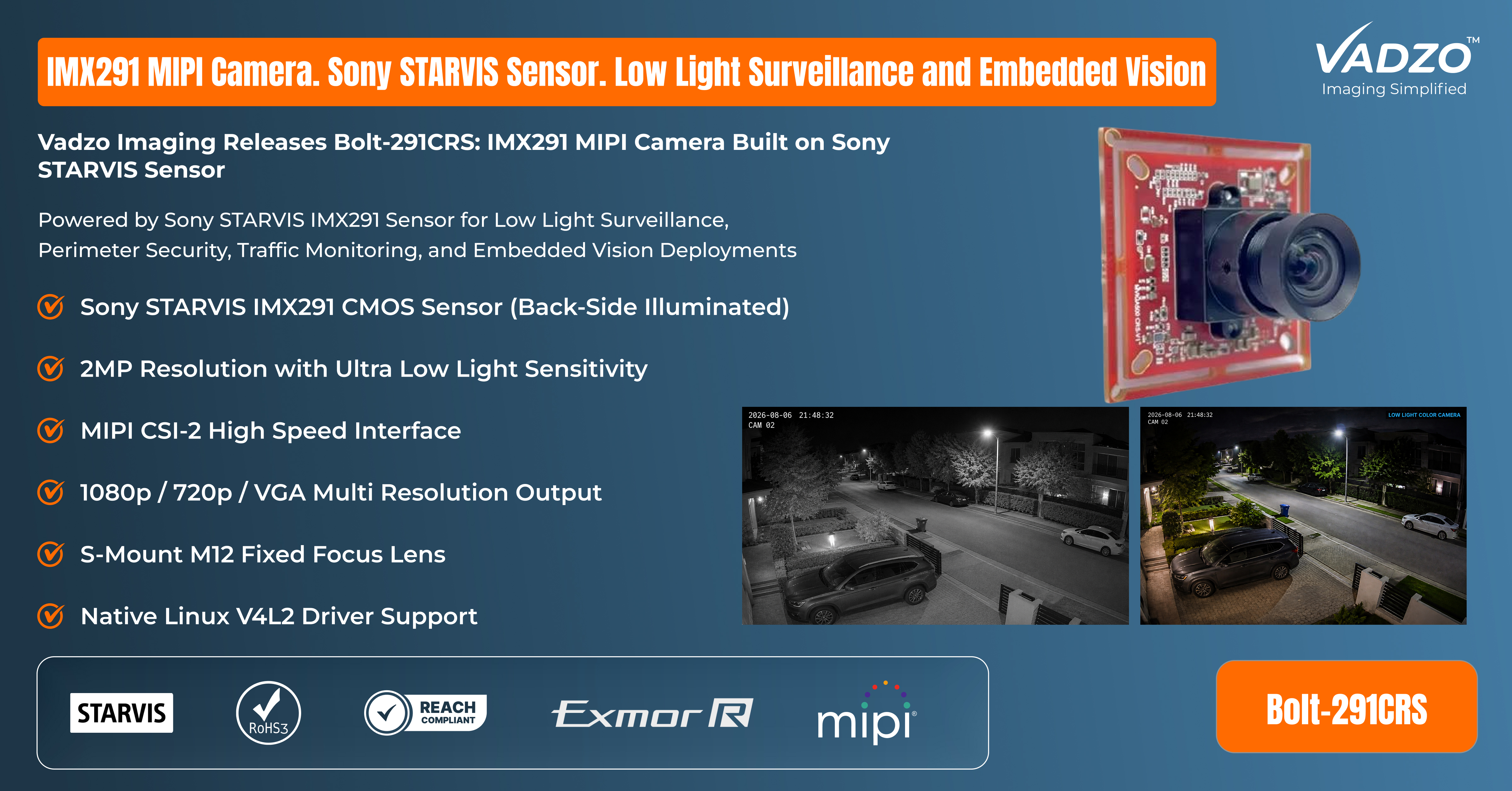
The Bolt-291CRS is a ultra low light MIPI camera module built on the Sony STARVIS IMX291 sensor. It is designed for surveillance, perimeter security, traffic monitoring, and embedded vision platforms that must operate reliably as ambient light drops toward darkness.
SAN JOSE, CA / ACCESS Newswire / August 10, 2026 / Vadzo Imaging makes embedded vision camera products for OEMs and system integrators. Today the company released the Bolt-291CRS. This is an IMX291 MIPI Camera built on a Sony STARVIS sensor with native low-light sensitivity for surveillance and embedded vision deployments where added illumination is impractical or undesirable.
The Illumination Problem in Surveillance and Embedded Vision Deployments
Standard rolling shutter color sensors need enough incident light to produce a clean, usable frame. Surveillance and embedded vision deployments frequently do not have that luxury. Parking lots dim after sunset. Perimeter fences sit far from any light fixture. Traffic monitoring systems must read on a plate at two in the morning under nothing but distant streetlight glow. A Sony IMX291 camera addresses this directly by capturing usable detail from ambient light levels that would leave a conventional sensor producing a noisy, unusable frame.
The common workaround is adding infrared illumination, but that introduces its own problems. Extra illuminators add cost, wiring, and failure point. They also emit a visible or near-infrared glow that can reveal a camera position, which works against any installation that depends on staying unnoticed. An IMX291 Sensor solves the underlying problem at the pixel level, so the camera module can rely on whatever ambient light is already present rather than adding a light source that draws attention to itself.
STARVIS Sensor Architecture and MIPI CSI-2 Integration Behind the Bolt-291CRS
The Bolt-291CRS is built around the Sony STARVIS IMX291 Camera sensor, a 1/2.8 inch Back-Side Illuminated CMOS device with a 2.9-micron pixel pitch that delivers 2MP resolution in 1920 by 1080 pixels. Positioning the wiring layer behind the photodiode layer rather than in front of it lets more incoming photons reach each pixel, which is the core engineering reason a Sony STARVIS Camera captures a clean image at light levels that overwhelm a front-illuminated sensor of similar resolution.
This pixel architecture pairs with an IMX291 Low Light Sensor grade signal chain that keeps read noise low even as gain increases to compensate for darkness. The result is a Low Light MIPI Camera that produces a stable image rather than a grainy one when the sensor is pushed to its sensitivity limits.
Rather than routing image data through a USB controller, the Bolt-291CRS exposes its output directly over a 2-lane MIPI CSI-2 interface to the host processor. This removes an entire stage of serialization and power conversion from the capture path, which lowers system power draw and reduces latency between sensor readout and the frame reaching the image processing pipeline. An MIPI CSI-2 Low Light Camera architecture like this suits embedded surveillance platforms where every component in the power budget matters.
The IMX291 uses a rolling shutter readout well suited to the largely static framing typical of a fixed surveillance camera or a perimeter monitoring station. The module is rated across an operating range of negative 30 degrees Celsius to 70 degrees Celsius, so the same design can be deployed in an outdoor enclosure through seasonal temperature swings without a separate thermal qualification cycle.
Introducing the Bolt-291CRS Low Light MIPI Camera Platform
The Bolt-291CRS is Vadzo Imaging’s newest addition to its Bolt MIPI camera series and its first entry built specifically around Sony STARVIS for low light performance. As an IMX291 MIPI Camera, the module pairs the sensor with a factory-calibrated S-Mount lens in a compact form factor designed for direct integration into embedded surveillance and vision systems.
System integrators building an Embedded Vision Low Light Camera deployment need a sensor that performs at the edges of available light without adding system complexity. Configured as a Low Light Embedded Vision Camera, the Bolt-291CRS delivers that performance directly over MIPI CSI-2 so engineering teams can focus on the surveillance application rather than compensating for a sensor that struggles after dark.
STARVIS Back-Side Illuminated Sensor for Ultra Low Light Capture
Conventional front illuminated sensors lose a meaningful share of incoming light to the wiring layer sitting on top of the photodiode. A STARVIS Low Light Camera avoids that loss entirely by placing the photodiode above the wiring layer, so nearly every available photon reaches the light-sensitive area. The Bolt-291CRS uses this back-side illuminated architecture to function as an Ultra Low Light Camera capable of producing color detail at light levels close to moonlight without any added illumination.
High Sensitivity Imaging Without Added Illumination
Adding infrared illuminators to reach usable sensitivity is a common workaround, but it increases cost, wiring complexity, and power to draw. A High Sensitivity Low Light Camera solves this natively at the sensor level. The Bolt-291CRS functions as a Night Vision Sensor Camera that relies on native pixel sensitivity rather than an external light source, which keeps the total installation simpler and less expensive to deploy at scale.
2MP Resolution Tuned for Low Light Performance
Resolution and low light sensitivity work against each other on a fixed sensor size because smaller pixels are needed for higher resolution to collect less light. Vadzo Imaging tunes this trade-off deliberately, choosing a Low Light CMOS Camera pixel geometry that favors sensitivity over pixel count. The result is a 2MP MIPI Camera that stays clean and usable long after a higher resolution sensor is overwhelmed by noise.
MIPI CSI-2 Direct Embedded Integration
The Bolt-291CRS connects directly to any MIPI CSI-2 host port on Raspberry Pi, NVIDIA Jetson, NXP i.MX8, and Rockchip platforms without a USB bridge board. Positioned as a 1080p Low Light Camera, it delivers full 1080p capture directly into the embedded processor image pipeline. As a 2MP Low Light MIPI Camera, the module ships with Linux V4L2 drivers and device tree overlays ready for immediate integration.
Compact S-Mount Module for OEM Surveillance Deployment
OEM surveillance products need hardware that fits inside a small dome, bullet, or covert enclosure. The Bolt-291CRS ships in a compact S-Mount module footprint that functions as a 1080p STARVIS Camera suitable for space-constrained enclosures. Built as an Embedded MIPI Camera Module, it gives OEMs a low-light-optimized platform ready to fit into an existing dome, bullet, or covert camera housing design.
Wide Operating Temperature and OEM Ready Module Design
Perimeter and traffic installations sit outdoors throughout every season without climate control. The Bolt-291CRS is rated from negative 20 degrees Celsius to 60 degrees Celsius, so the same design holds up in a hot summer enclosure and a cold winter night alike. Offered as an OEM Low Light Camera Module, it gives integrators a low light platform that is already qualified for the outdoor temperature range their deployment requires rather than a lab-grade part that still needs field hardening.
“Sensitivity used to mean adding lighter. Now it means capturing what is already there. The Bolt-291CRS pairs the Sony STARVIS IMX291 sensor with a direct MIPI CSI-2 connection, so surveillance and embedded vision teams get a camera module that performs after dark without extra illumination or extra power draw. That lets OEMs deploy fewer components in the field and spend their engineering effort on the application instead of compensating for a sensor that cannot see in the dark.” – Alwin Vincent, Product Manager, Vadzo Imaging.
Applications
Security and Surveillance Camera Deployment: Fixed security installations need dependable image quality from dusk through dawn without relying on visible illumination. Functioning as a MIPI Surveillance Camera, the Bolt-291CRS delivers usable detail well after sunset. Built as an Embedded Surveillance Camera, it integrates directly into existing recording and edge AI pipelines over MIPI CSI-2 without an intermediate USB bridge.
Perimeter and Nighttime Monitoring: Perimeter fences and remote property lines often sit far from grid power and artificial lighting. A Low Light Perimeter Camera needs to make the most of whatever ambient light reaches the scene. Deployed as a Night Surveillance MIPI Camera, the Bolt-291CRS gives perimeter security systems a dependable image through the darkest parts of the night.
Traffic Monitoring in Low Light Conditions: License plate capture and vehicle classification do not stop when the sun goes down. A Low Light Traffic Camera needs to resolve fine plate detail under nothing but streetlight and headlight glow. The Bolt-291CRS handles this scenario directly through its native sensitivity rather than depending on supplemental lighting that traffic authorities may not want to install along every route.
Covert and Discreet Surveillance Installations: Some monitoring applications depend on the camera staying unnoticed. A Covert Surveillance Camera cannot give away its position with a visible or infrared glow. The Bolt-291CRS produces usable detail from ambient light alone, which lets integrators build discreet monitoring solutions for sensitive sites without a telltale illumination source.
Edge AI Surveillance and Embedded Vision: AI-powered analytics need clean input frames around the clock, not just during daylight hours. Deployed as a Low Light AI Surveillance Camera, the Bolt-291CRS feeds detection and classification models with usable frames after dark so an analytics pipeline does not lose accuracy the moment the light drops.
Frequently Asked Questions
Q: Why might a system integrator choose a highly light-sensitive camera module instead of adding infrared illuminators to a surveillance installation?
A: Infrared illuminators solve the darkness problem by adding light the human eye cannot see, but they also add cost, additional wiring, and a component that can fail or draw unwanted attention to a covert installation. A camera module built around a highly light-sensitive sensor captures a usable image directly from available ambient light such as starlight or distant sky glow without adding a visible or infrared light source. This keeps the installation simpler, lowers the total bill of materials, and avoids giving away the camera position with a visible glow, which matters for perimeter security and discreet monitoring applications where the goal is to observe without being noticed.
Q: How does a MIPI interface camera module reduce power draw compared to a USB camera module in a solar-powered or battery-powered surveillance deployment?
A: A MIPI CSI-2 camera module connects directly to the image processor on the host board without the USB controller, hub circuitry, and voltage regulation stages that a USB camera module typically requires. Removing that extra silicon lowers the total power budget of the capture path, which matters directly for remote surveillance nodes running from a battery bank or a small solar panel. Every milliwatt saved on the camera extends runtime for the rest of the system, including radios, storage, and any onboard AI inference hardware, which is why Vadzo Imaging designs its MIPI camera products with power efficiency as a core requirement rather than an afterthought.
Q: What role does pixel size play in how well a camera module performs as ambient light drops toward darkness?
A: A larger pixel collects more photons in each exposure window than a smaller pixel on the same sensor generation, which directly improves signal strength relative to noise as available light decreases. Vadzo Imaging selects sensors with pixel geometry tuned for the actual lighting conditions of the target application rather than maximizing resolution alone, because a marketing-focused resolution number means little if the resulting image is too noisy to use once the sun goes down. This engineering trade-off between pixel size and resolution is central to how Vadzo builds camera products for genuine low-light performance.
Q: Why is discreet or covert surveillance easier to achieve with a camera that does not rely on visible or infrared illumination?
A: Any added light source, visible or infrared, can reveal that a camera is present and active, which defeats the purpose of a discreet or covert installation. A camera module that produces a usable image from naturally available ambient light removes that giveaway entirely and lets the installation blend into its surroundings. Vadzo Imaging builds its low light camera products specifically to give integrators this option, so covert monitoring, perimeter security, and sensitive site surveillance can be deployed without a visible tell that draws attention to the equipment.
Q: How does Vadzo Imaging support OEM customers who want to qualify a low light camera module for an existing embedded vision product line?
A: Vadzo Imaging works with OEM engineering teams to validate a low light camera module against their specific enclosure, lens, and processing platform before any production commitment is made. Support includes lens and focus customization, firmware adjustments for exposure and gain tuning, mechanical changes to fit an existing housing, and direct applications engineering guidance for pairing the module with the customer-chosen embedded platform. Every evaluation kit ships with driver documentation and sample capture code, so an engineering team can confirm real-world low-light performance in their own product before scaling to volume. Vadzo Imaging is proud to support that qualification process from first sample through full production.
Availability
The Bolt-291CRS IMX291 MIPI Camera, built on the Sony STARVIS sensor, is now available for evaluation and production orders. Evaluation kits include the camera module, S-Mount fixed focus lens, MIPI CSI-2 flex cable, and platform driver documentation with no minimum order requirement. As a trusted Low Light Camera Manufacturer, Vadzo Imaging supports OEM customers from early evaluation through volume production. Browse the full Vadzo camera portfolio at https://www.vadzoimaging.com/ or contact Vadzo at support@vadzoimaging.com to request an evaluation kit or discuss OEM integration requirements.
About Vadzo Imaging
Vadzo Imaging is a global provider of embedded vision solutions and delivers high-performance camera technologies and imaging platforms for applications in robotics, industrial automation, UAVs, edge AI, and medical systems. Its products are designed for seamless integration with leading embedded platforms. Vadzo supports customers through hardware customization, firmware development, and module-level drivers, enabling faster development and deployment of vision-based systems.
Media Contact
Alwin Vincent
Vadzo Imaging
Email: alwin@vadzoimaging.com
LinkedIn: Vadzo Imaging
YouTube: Vadzo Imaging
X: Vadzo Imaging
SOURCE: Vadzo Imaging
View the original press release on ACCESS Newswire
Media gallery