

The Armor-234CGS is an AR0234 Global Shutter FPD-Link III Camera, and Vadzo Imaging is launching it with color imaging for embedded vision systems. Machines that move need pictures that stay true. A robot turns a corner, a vehicle passes a camera at highway speed, a pick-and-place arm swings across a bin, and a sensor that reads its picture line by line records each of these as a bent image. A global shutter exposes every pixel at the same instant, so motion is frozen without skew. The Armor-234CGS pairs a 1920 x 1200 color global shutter sensor, with large 3-micron pixels for strong sensitivity and low noise, with an FPD-Link III link that carries the video over a single coaxial cable together with control and power. Low-latency streaming, multi-camera readiness, and a rugged build complete it. As a 2.3MP Color FPD-Link III Camera and an AR0234 Color FPD-Link III Camera, it supplies accurate color frames to vision software.
FORT WORTH, TX / ACCESS Newswire / November 25, 2026 / Vadzo Imaging, a provider of embedded vision camera products for OEMs and system integrators, today launches the Armor-234CGS, an AR0234 Global Shutter FPD-Link III Camera with color imaging for embedded vision systems. Part of Vadzo’s SerDes camera portfolio, it combines 2.3MP color resolution, large 3-micron pixels, and FPD-Link III long-distance transmission with a single-cable design, low-latency streaming, and multi-camera readiness. Vadzo presents a 2.3MP Color FPD-Link III Camera and an AR0234 Color FPD-Link III Camera for robots, vehicles, inspection stations, and surveillance systems, with guidance on frame rate, link bandwidth, and wiring.
Why an AR0234 Global Shutter FPD-Link III Camera Keeps Moving Scenes True
Embedded vision systems work in motion. The robot, the vehicle, the arm, and the target all move, and often at the same time. Most image sensors read the picture row by row, and while they read, the scene keeps moving, so each row records it from a slightly different place. Straight edges lean, wheels become ovals, and a license plate stretches. Software that reads plates, measures parts, or stitches several views together inherits the distortion, and it cannot remove it, because it does not know how everything moved during the readout.
A global shutter removes the problem at its source. All pixels are exposed and held at the same instant and then read out, so the frame is a true snapshot. Color adds a second need. Many tasks depend on it, such as reading the color of a plate or a light, telling a safety vest from a pallet, or showing a driver a natural-looking surround view. A color sensor puts a filter in front of each pixel, and the filters absorb part of the light, so a color global shutter sensor needs large pixels to keep its sensitivity, which is the reason for the 3-micron pixels of this sensor.
Distance is the third problem. The camera units of such systems sit on bumpers, mirrors, masts, gantries, and robot arms, and the computers sit elsewhere, protected from vibration, dust, and heat. A short parallel ribbon cable cannot span the gap, and a long one carries noise and fails at connectors. A serial link turns the sensor output into one fast stream that travels over coaxial cable, with control commands returning on the same cable and power sharing it. Vehicles and machines already use such links, and engineers who work in them expect them to be robust.
Integration closes the list. A system with several camera units wants their frames to be taken at the same moment, wants the delay between the scene and the decision to stay small, and wants a body that survives the field. Teams that choose a camera for one of these needs and discover the others later must redesign after the hardware is built, and a clear view of all of them at the start saves that work.
How an AR0234 Global Shutter FPD-Link III Camera Moves True Color Frames Over One Cable
The Armor-234CGS is built on the Onsemi AR0234, a 2.3MP (1920 x 1200) color global shutter sensor with a 1/2.6 inch optical format and 3.0 micron pixels. Because every pixel is exposed at once, the frame carries no skew, and the large pixels collect more light than the small pixels of high-resolution sensors, which gives strong sensitivity and low noise in the short exposures that motion demands. A serializer on the camera converts the sensor output into a fast serial stream, and a deserializer on the host converts it back into a standard camera interface. FPD-Link III is the serializer and deserializer family of Texas Instruments, and it carries video on a forward channel over coaxial cable or shielded twisted pair, with control commands travelling back on a slower channel. It is an AR0234 FPD-Link III SerDes Camera in the sense that the serial link is part of the module, and teams that need only the camera board can discuss a module configuration with Vadzo.
A short calculation shows how well the sensor fits the link. A 1920 x 1200 frame at 10 bits per pixel is about 23 million bits, so 60 frames per second needs about 1.4 gigabits per second and 120 frames per second needs about 2.8 gigabits per second. The higher-speed FPD-Link III devices carry video at a forward rate of about 4 gigabits per second, a figure teams should confirm for the serializer in use, so a raw 10-bit stream at 120 frames per second fits with margin. A 16-bit color format at 120 frames per second would need about 4.4 gigabits per second and does not fit, while the same format at 60 frames per second needs about 2.2 and does. This is a far easier case than the 20MP sensors of the other FPD-Link III camera units, where full resolution at a high frame rate exceeds the link. The figures are illustrative, since real streams depend on the output format and on protocol overhead, and teams should confirm the available modes against the product documentation.
A worked example shows why the global shutter matters for license plate recognition. A vehicle at 100 kilometers per hour travels about 27.8 meters per second. With a lens of 12 millimeters and 3-micron pixels, each pixel covers about 2.5 millimeters at a distance of 10 meters, so a plate 300 millimeters wide spans about 120 pixels, which most recognition software reads reliably. An exposure of 200 microseconds moves the vehicle about 5.6 millimeters, about 2 pixels of blur, which is tolerable. A rolling shutter reading the frame over 10 milliseconds would shift the bottom of the plate by 28 centimeters relative to the top, wrecking the geometry. The global shutter keeps the plate rectangular, and a short exposure keeps it sharp. The figures are illustrative, and a real system must also consider the angle of the plate, the lighting, and the reflectivity of the plate.
Surround view systems show a second benefit. Several camera units around a vehicle are stitched into one view, and the seams between them must match. With a rolling shutter, a vehicle that turns or a pedestrian that crosses a seam appears bent differently in neighboring views, and the stitched picture shows tears. With a global shutter, each view is a true snapshot, and the seams agree. A FPD-Link III Multi-Camera setup uses a multi-port deserializer to receive several camera links, and frame synchronization signals sent over the control channel can start the units at the same moment. The total data must fit the lanes of the host. For example, four units at 10 bits per pixel and 60 frames per second would deliver about 5.5 gigabits per second to the host, and teams should plan the rates accordingly.
The single cable design carries video, control data, and power on one coaxial cable, which is the idea behind a power over coax link. A 2.3MP Power over Coax FPD-Link III Camera takes its supply from the same cable, so there is no separate power run to the camera. Power over a long cable loses voltage in proportion to the current. For example, a run with 1.2 ohms of round-trip resistance drops about 0.24 volts at 0.2 amperes, and the camera and the supply must tolerate that drop, so teams should confirm the power budget and the voltage range for their cable length. Connectors deserve attention too. Automotive coaxial links commonly use keyed, color-coded connectors, a family known as FAKRA, and a FPD-Link III FAKRA Camera relies on that locking design to survive vibration, so teams should confirm which connector this camera uses and choose a matching cable and strain relief.
The host side needs care. A Jetson module reads camera modules through MIPI CSI-2 lanes, so a 2.3MP FPD-Link III Jetson Camera needs a deserializer board that converts the serial stream back into MIPI CSI-2 and connects to the module, and teams should confirm which board Vadzo supplies for the platform they use, and the drivers and lane settings for it. Latency depends on the whole chain. The serializer and deserializer add very little, since the transfer is direct and uncompressed, and at 120 frames per second a frame takes only 8.3 milliseconds, so the delay from the scene to the host can be short. Teams should measure the full path, for example by filming a running timer on a display. A rugged build, with a secure connector and a housing that resists vibration, completes the design, and teams should confirm the environmental ratings in the product documentation.
Pick and place work shows the value of speed and truth together. Suppose an arm moves at 1.5 meters per second across a bin 400 millimeters wide, so each of the 1920 pixels covers about 0.21 millimeters. An exposure of 200 microseconds moves the arm 0.3 millimeters, about 1.4 pixels of blur, which a detector tolerates. A rolling shutter that takes 10 milliseconds to read the frame would shift the bottom of the picture by 15 millimeters relative to the top, about 72 pixels, which would put the part in the wrong place for the gripper. A global shutter removes that error, and a trigger or a fixed delay after the arm stops removes most of the blur. Warehouse robots meet a milder version of the same problem. A cart moving at 1.5 meters per second travels 2.5 centimeters between frames at 60 frames per second, so features shift by only a few pixels, and the tracker stays locked. The figures are illustrative.
A short evaluation plan helps teams avoid surprises. They should mount the camera on the real platform with the real cable and connector, record in the darkest and brightest conditions the system will meet, and measure the frame rate, the delay, and the voltage at the camera in each mode. For multi-camera systems, they should check the timing between units with a flashing light, and repeat the check with the full number of units, since the load on the host grows with each one. They should leave the system running for a long period to see how the link and the module behave as they warm up. Problems with connectors, cable bends, and power usually show up in such a test long before they show up on a bench, and Vadzo can review the results with a customer during evaluation, so that the first production unit behaves like the one on the test rig.
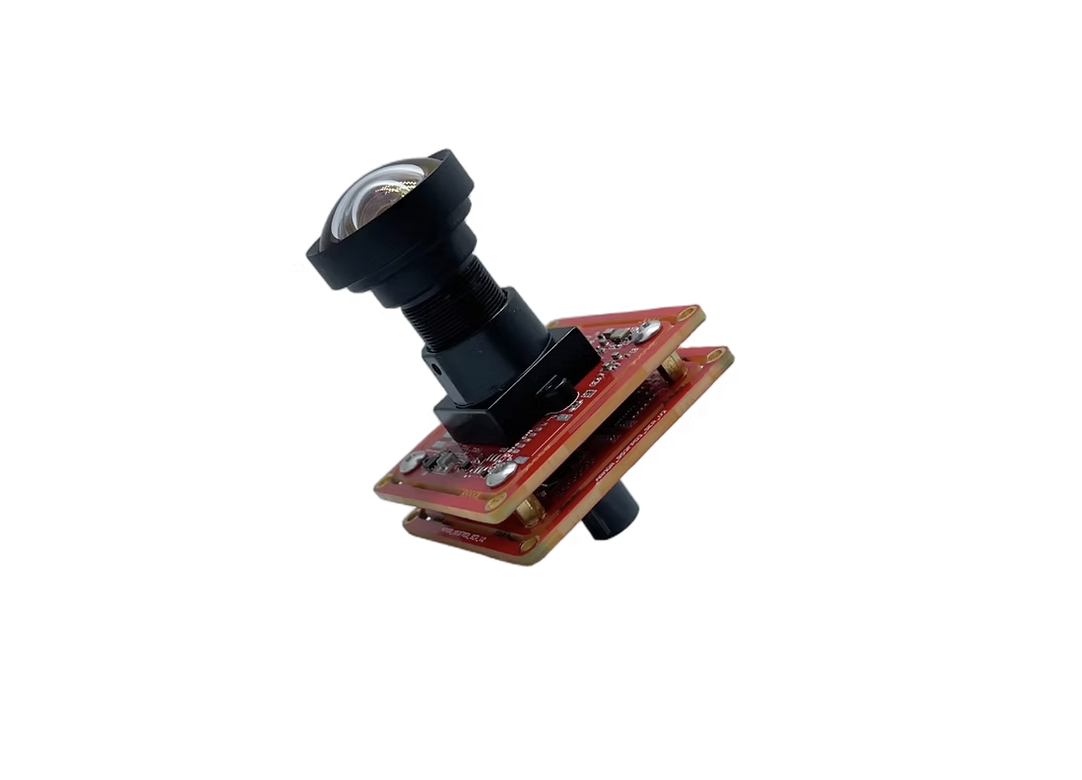
Product Overview: AR0234 Global Shutter FPD-Link III Camera for Embedded Vision Systems
The Armor-234CGS is a 2.3MP color global shutter FPD-Link III module built on the Onsemi AR0234 sensor. As an AR0234 FPD-Link III Camera, it combines a global shutter sensor with a long-distance link, and as an AR0234 FPD-Link III Camera Module, it fits designs that need a compact module. The 2.3MP FPD-Link III Global Shutter Camera designation covers its shutter and its link, and the 2.3MP Color FPD-Link III Camera Module designation covers its color output. The module also serves as an AR0234 FPD-Link III Embedded Camera, an AR0234 FPD-Link III Coax Camera, and a Rugged Embedded Camera for engineers who build vehicle, robot, and field systems. Vadzo also builds a Custom FPD-Link III Camera on request, with a different lens, connector, or cable length.
Key specs: 2.3MP (1920 x 1200) Max Resolution | Onsemi AR0234 1/2.6 inch Sensor Format | 3.0 micron Pixel | Color with Global Shutter | FPD-Link III SerDes Interface | Lens per Module Configuration
Key Capabilities of the AR0234 Global Shutter FPD-Link III Camera
Global Shutter Sensor
The global shutter freezes motion with no rolling artifacts because every pixel is exposed at the same instant, which gives accurate tracking and measurement. Straight lines stay straight, and plates stay rectangular. A global shutter does not remove blur from a long exposure, so short exposures remain important, and lens distortion still needs calibration.
2.3MP Color Resolution
The sensor delivers 1920 x 1200 output in color, which balances detail with fast processing. In the illustrative example, a plate 300 millimeters wide spans about 120 pixels at 10 meters with a 12-millimeter lens. Color helps with plates, lights, vests, and surround views, and teams that need only brightness can choose a monochrome module from the same family.
Large 3 Micron Pixels
The 3-micron pixels collect more light than the small pixels of high-resolution sensors, which gives strong sensitivity and low noise in short exposures and dim scenes. The color filters absorb part of the light, and large pixels compensate. A lens with a wide aperture and steady illumination help further, and teams should test at the darkest light they expect.
Long Distance Transmission
FPD-Link III sends high-speed video over coaxial cable across long runs between the module and the host, so the camera can sit where the view is and the computer where it is protected. A raw 10-bit stream at 120 frames per second fits the forward rate in the illustrative calculation. Teams should confirm the cable length and the connector for their design, and the output format.
Single Cable Design
Video, control data, and power travel on one cable, which cuts wiring and installation time. A long cable drops voltage as current flows, so the power budget and the voltage range should be checked for the real run. As a 2.3MP FPD-Link III Camera supplier and the maker of a custom module, Vadzo supports deserializer selection, cable planning, and enclosure design for volume programs.
Low Latency Streaming
Direct SerDes transfer keeps delay low for real-time decisions in moving systems, since the stream is not compressed. At 120 frames per second, a frame takes 8.3 milliseconds, so the whole chain can respond quickly, and the sensor readout and the host processing usually add more than the link, so the full path should be measured.
Multi Camera Readiness
The module works with multi-port deserializers for synchronized multi-camera setups, so frames from several units can be matched in time, which surround views and wide-area coverage need. The total bandwidth into the host must fit its lanes, and teams should plan it before choosing the number of units and the frame rate of each.
Rugged Armor Build
The module is designed for vibration and harsh field conditions in automotive and industrial use. Teams should confirm the environmental ratings in the product documentation, secure the connector with the right cable and strain relief, and test the module on the real platform, since a cable that passes on the bench can behave differently beside a motor.
“Moving scenes punish rolling shutters, and vehicles and robots are always moving. The Armor-234CGS pairs a global shutter with large 3-micron color pixels and a link that puts video, control, and power on one coaxial cable. At 2.3MP, the link has room to spare, which is not true of larger sensors. We are plain about the limits. A global shutter does not cure the blur of a long exposure, color filters cost some light, long cables drop voltage, and a Jetson needs a deserializer board. We help customers plan the link, the connector, and the host before they commit.” – Alwin Vincent, Product Manager, Vadzo Imaging.
Application Specific Sections: Global Shutter Color Vision in Practice
Automation and Robotics
Robots, vehicles, and factory cells carry camera units on moving parts, far from their compute modules. The Armor-234CGS works as an Autonomous mobile robot’s FPD-Link III Camera for navigation and obstacle tracking, as a Robotic navigation FPD-Link III Camera that feeds a tracker with skew-free color frames, and as an unmanned ground vehicle’s FPD-Link III Camera on rugged platforms where a thin coaxial cable replaces a bundle of wires. Teams should check weight and connector retention, and should test navigation at the speeds of the real platform.
Warehouses and production lines add fast, repeated motion. The module serves as an FPD-Link III Warehouse Camera for shelf, pallet, and vest recognition, as an Industrial inspection FPD-Link III Camera where the global shutter keeps moving parts undistorted, and in FPD-Link III Pick-and-Place cells where an arm swings across a bin and the picture must show where the part really is. A strobe with a short exposure freezes the fastest parts, and a fixed lens that is locked in place keeps the calibration of the arm and the camera valid.
Telematics and Fleet Management
Vehicles carry several camera units around the body. The camera works as a surround-view system’s FPD-Link III Camera unit whose global shutter keeps the stitched seams aligned, and as a FPD-Link III ADAS Camera candidate for driver assistance development, where color shows lights and signs. The brief does not state automotive qualification or functional safety, so teams should confirm what their program requires.
Security and Surveillance
Roads, gates, and fences need camera units that read and watch. The module serves as a license plate recognition FPD-Link III Camera that keeps plates rectangular at speed, and as a FPD-Link III Perimeter Monitoring Camera where one cable simplifies mounting on poles and masts. Privacy and recording rules apply to plates and video and belong to the operator.
Frequently Asked Questions
Q: Why does a license plate camera need a global shutter?
A: Vadzo Imaging explains that a vehicle at 100 kilometers per hour travels about 27.8 meters per second. A rolling shutter that reads the frame over 10 milliseconds shifts the bottom of the plate by about 28 centimeters relative to the top, which bends the characters. A global shutter exposes every pixel at once, so the plate stays rectangular, and a short exposure of 200 microseconds keeps it sharp. These figures are illustrative.
Q: Can one FPD-Link III link carry a 120 frames per second stream from a 2.3MP sensor?
A: It depends on the format. A 1920 x 1200 frame at 10 bits per pixel is about 23 million bits, so 120 frames per second needs about 2.8 gigabits per second, which fits within the forward rate of about 4 gigabits per second of the higher-speed devices. A 16-bit color format at the same rate would need about 4.4 gigabits per second and would not fit within the forward rate. Vadzo Imaging recommends confirming the available modes and the forward rate.
Q: What does power over coax mean for a camera?
A: It means the supply puts power onto the same coaxial cable that carries the video and the control commands, and the camera takes it off at its end, so no separate power wire is needed. A long cable loses voltage as current flows. For example, 1.2 ohms of round-trip resistance drops about 0.24 volts at 0.2 amperes. Vadzo Imaging recommends checking the power budget and the voltage range for the real cable length, since a 2.3MP Power over Coax FPD-Link III Camera depends on that supply.
Q: Why do surround view systems benefit from a global shutter?
A: Several camera units around a vehicle are stitched into one view, and the seams between them must match. With a rolling shutter, a turning vehicle or a crossing pedestrian appears bent differently in neighboring views, and the stitched picture tears at the seams. A global shutter makes each view a true snapshot. Vadzo Imaging suggests synchronizing the units and testing the stitched view with real motion, and a FPD-Link III Multi-Camera setup should be checked with the full number of units.
Q: Why should integrators choose Vadzo Imaging as their 2.3MP FPD-Link III camera supplier?
A: Vadzo Imaging offers more than a camera module built around a capable sensor. Integrators receive a color global shutter module with a single-cable design, low-latency streaming, multi-camera readiness, and a rugged build, with candid guidance on link bandwidth, voltage drop, connectors, and the details to confirm in the documentation, plus engineering support for deserializer selection, lens selection, firmware customization, and enclosure design. Vadzo Imaging maintains evaluation kits with no minimum order requirement, so teams can test on their own platform before committing to volume production.
Availability
The Armor-234CGS AR0234 Global Shutter FPD-Link III Camera, built on the Onsemi AR0234 sensor, is available now for evaluation and production orders. Evaluation kits include the camera module, a cable, a deserializer board, and platform documentation, with no minimum order requirement. Integration teams can test frame rates against their own link, measure voltage drop on their own cable, check plate capture at their own speeds, and try multi-camera synchronization on their own host before committing to a production bill of materials, which tells them more than a datasheet comparison alone. Teams that need a different lens, connector, or cable length can ask Vadzo to review the setup. Browse the full range of camera options at Vadzo’s website or discuss OEM integration requirements.
About Vadzo Imaging
Vadzo Imaging is a global provider of embedded vision solutions and delivers high-performance camera technologies and imaging platforms for applications in robotics, industrial automation, UAVs, edge AI, and medical systems. Its products are designed for seamless integration with leading embedded platforms including NVIDIA Jetson, Rockchip, Raspberry Pi, and NXP i.MX. Vadzo supports customers through hardware customization, firmware development, and module-level drivers, enabling faster development and deployment of vision based systems across MIPI, USB, GigE, Wi-Fi, GMSL2, FPD-Link III, and SerDes camera interfaces.
Media Contact
Alwin Vincent
Vadzo Imaging
Email: alwin@vadzoimaging.com
LinkedIn: Vadzo Imaging
YouTube: Vadzo Imaging
X: Vadzo Imaging
SOURCE: Vadzo Imaging
View the original press release on ACCESS Newswire
Media gallery